A-level Maths
A one-to-one A-level Maths course that rebuilds shaky topics first, then works steadily through the past paper questions your child will meet in the summer exams.
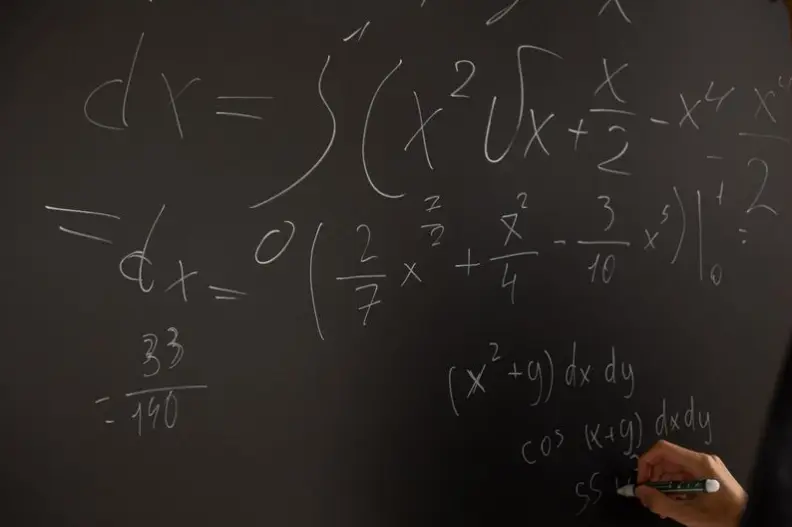
What one-to-one A-level Maths tuition covers
Sound Footing Tuition teaches A-level Maths to sixth formers in Year 12 and Year 13, one to one, online or at home. Every lesson is with a DBS-checked, qualified tutor who holds a degree in maths or a closely related subject, and the work sits under our head of sciences, who reads lesson notes across the team and keeps the standard level from tutor to tutor. Our whole pupil list runs from age 7 to 18, but the content on this page is A-level only, matched to the specification your child's school actually teaches, whether that is Edexcel, AQA, OCR or MEI.
A-level Maths is three subjects wearing one name: pure, mechanics and statistics. Most of the difficulty we meet is not in the new material but in the algebra underneath it. A pupil who cannot rearrange a surd or split an algebraic fraction with any confidence will drop marks on a pulley question in mechanics and never work out why. So we find those cracks first, then work outward through the specification to the question types that appear in the summer papers.
Who this suits, and who it does not
This course fits pupils who are already capable but uneven. Year 12 students who lost a term to illness, a change of teacher or a topic that never landed. Year 13 students who need a particular grade for a university offer and know exactly how many marks stand between them and it. Students who cope in class but freeze when a question is worded differently from the textbook. Students resitting the summer after a disappointing result, who need a plan rather than a repeat of the same lessons.
It suits families who want the detail, too. You get written notes after every lesson and progress reports for parents, so you are not relying on a fortnightly guess about whether anything is happening.
It is not the right fit for everyone. If your child wants a class to sit in and listen to, one-to-one will feel exposing. If they will not attempt the short set of questions between lessons, progress stalls and the fee buys much less than it should. If they are studying IB, Scottish Highers or a Core Maths qualification, say so on the phone and we will tell you honestly whether we are the right team. And we are not a replacement for school attendance; we work alongside the timetable, not around it.
How the course works, step by step
Step one: a proper conversation
You call or email with three things: the exam board and specification code, the target grade with the university offer behind it, and the dates of any mocks. If you have a recent school report or a marked mock script, send it. That first conversation costs nothing and it shapes everything after it.
Step two: a diagnostic, not a guess
The first lesson is diagnostic. The tutor works through a handful of questions chosen to test the foundations of pure, then a short mechanics or statistics item, and builds a list of gaps in order of how much they cost in marks. Most pupils arrive expecting to start on calculus and discover the real blockage sits two chapters earlier.
Step three: a written plan against the specification
From the diagnostic we produce a plan mapped to the specification: which pure topics need rebuilding, where mechanics needs a second pass, how much of the statistics content is coursework-free and exam-only, and which past papers to hold back for the Easter run-in. You see the plan and you can challenge it.
Step four: weekly lessons and marked homework
Lessons are one to one, online or at home. Each one closes with a short set of questions, and the tutor marks them before the next session. We keep an error log for your child, a single running list of the mistakes that keep returning, so revision in April is aimed at their own weak spots rather than a generic checklist.
Step five: notes and progress reports
After each lesson the tutor writes up what was covered, the method used and what to try next. Those recorded notes mean a missed week does not become a lost month, and a parent can read exactly what was taught. Progress reports for parents follow at an interval you agree at the start, and you can ask for one ahead of a parents' evening or a UCAS deadline.
Step six: the exam run-in
From the Easter holidays the emphasis shifts to timed questions under exam conditions, then marking against the mark scheme, then rewriting the parts that lost marks. Past paper work is where the course pays for itself, and pupils who want a heavier focus on it can add our A-level Past Paper Review sessions alongside their maths lessons.
What your child needs to bring to the first lesson
- The exam board and specification code, or a photo of the front of their textbook.
- Their exercise book, folder or whatever their school uses, plus any marked mock or assessment.
- The calculator they will actually use in the exam, and the formula booklet if their board issues one.
- A quiet room, a charged laptop and a working camera for online lessons.
For home lessons, we confirm availability for your postcode when you book, so tell us your area early. A sixth former in Didsbury and one out towards Rochdale are not the same journey on a wet Tuesday in February.
What affects the timing and the cost
Fees are on request and we confirm them when you book, together with the times your tutor can offer. Several things move the total. The number of lessons a week matters most: one lesson a week through Year 12 is a different proposition from two a week from February of Year 13. How much rebuilding is needed is the second factor, because a pupil who needs the whole of pure algebra revisited will need more sessions than one chasing the last few marks on vectors. Easter and May slots go first, since every sixth form in the area is hunting for the same few weeks.
Online lessons cost less than home visits in most cases, because travel comes out of the equation. The exam board can matter: a specification with a large mechanics weighting needs more preparation time than a statistics-led route. The recorded lesson notes and the parent progress reports come with the tuition rather than as a separate purchase, which is part of why families stay with one tutor across the whole two years instead of shopping around each term. Ask about bundling maths with chemistry, physics or biology if your child is taking more than one, since a shared timetable is easier to keep and easier to pay for.
Questions parents ask about A-level Maths tuition
My child is in Year 12 and seems to have forgotten their GCSE algebra. Is that a problem?
It is the most common starting point we see. The diagnostic is designed to catch it, and we usually spend the first few sessions on indices, surds, algebraic fractions and rearranging before moving on. Better to fix it in January of Year 12 than in April of Year 13.
Do you follow our school's exam board?
Yes. Tell us the board and specification code and the tutor works from that document, including its formula booklet and mark scheme conventions. We do not teach a generic syllabus and hope it lines up.
How do the progress reports work?
They are written for parents, not for pupils: what has been covered, what has improved, what is still weak, and what we plan to do about it. You agree the interval at the start. If something needs raising sooner, the tutor will raise it.
Can we switch between online and home lessons?
Often, yes. Online suits a busy week; home suits a pupil who works better with someone at the same table. Availability for both is confirmed when you book.
When is the best time to start?
The autumn of Year 12 gives the most room to work with. After that, the useful thing is not to wait for a bad mock result before calling. Tell us the mock dates and we will work backwards from them.
- 12 weeks
- 24 lessons
- Advanced
- Daniel Okonjo
On request for the full course
Skills your child leaves with
- ✓
Solve pure maths problems without stalling
- ✓
Work mechanics questions step by step
- ✓
Read statistics tables and interpret results
- ✓
Show method clearly to keep every mark
- ✓
Sit full past papers under time
How the weeks are laid out
-
Diagnostic first lesson
We find out where the gaps are, then agree which topics to tackle first and how the twelve weeks will run.
-
Pure maths foundations
Algebra, functions and calculus are revisited with short exercises after each explanation and marked before the next lesson.
-
Mechanics and statistics
Applied topics are taught through exam-style questions, with diagrams drawn out on the shared screen.
-
Past papers and timing
Full papers are marked against the real mark scheme, then the weakest questions are reworked the following week.
Start A-level Maths today
Book a first lesson and the tutor will map the weeks ahead before you commit to a full block.
Book a first lesson