GCSE Science
A one-to-one GCSE Science course that covers biology, chemistry and physics content and the longer written answers that decide the top grades.
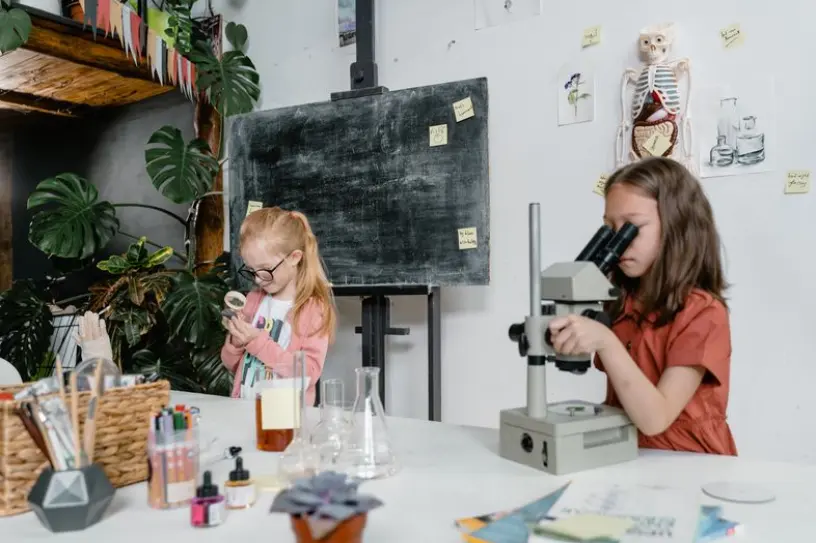
GCSE Science is three subjects wearing one timetable. Your child sits biology, chemistry and physics papers, whether as combined science or as separate triple science, and the marks that separate a grade 6 from a grade 8 usually sit in the six-mark written answers, the required practicals and the arithmetic hidden inside a physics question. One-to-one tuition gives us the time to work on those things at the pace your child actually learns.
Lessons run online or at home with a DBS-checked tutor who knows the specification your child sits, so AQA, Edexcel and OCR are all familiar ground. GCSE sits inside a wider service covering pupils aged 7 to 18, with maths, English and science taught by subject specialists.
What follows covers the content, who the course suits and who it does not, how the first weeks usually run, what to have ready on the day, and what moves the timing and the price.
What a GCSE Science course covers
Science at GCSE is really two qualifications in one. Combined science pupils cover all three disciplines and come out with two grades. Triple science pupils take biology, chemistry and physics as separate GCSEs. Both routes reward the same habits: knowing the vocabulary, describing a method in order, and explaining why a result changed. Lessons work on those habits rather than on reading the textbook aloud.
Biology, chemistry and physics content
Biology runs from cell structure and transport through infection and response, inheritance and variation, to ecosystems and the effect of human activity. Chemistry covers atomic structure and the periodic table, bonding, quantitative chemistry, rates and energy changes, organic chemistry and the atmosphere. Physics takes in energy stores, circuits, the particle model, forces and motion, waves, and magnetism.
Which topics get lesson time depends on your child's mock papers, the school's teaching order and the exam dates. A pupil whose last assessment was strong on ecology and weak on electrolysis will spend the next few sessions on electrolysis.
The long written answers
Six-mark questions are where prepared pupils pull ahead. We teach a repeatable structure: state the point, give the science, apply it to the context in the question, then close with a consequence. Command words matter. "Describe" and "explain" want different answers, and a pupil who mixes them up loses marks they knew the science for.
Required practicals get their own attention, because written questions about apparatus, variables and sources of error are worth a fixed share of the marks and cannot be revised from a summary sheet alone. Maths skills run alongside: significant figures, unit conversions, rearranging an equation before substituting, and reading a gradient from a graph.
Who the course suits, and who it does not
A good fit if
- Your child is in Year 9, 10 or 11 and sitting combined or triple science.
- They understand the content in class but lose marks on longer answers or on questions set in an unfamiliar context.
- They are close to a grade boundary and a handful of marks would change the outcome.
- School has moved sets, changed exam board, or missed practicals through staff absence.
- They are home educated and need a steady, examined route through the specification.
Probably not the right fit if
- You want a group class. Every lesson here is one-to-one, which means the hour follows your child rather than a fixed scheme.
- You are looking for the whole syllabus to be taught in the last fortnight before exams. We will be honest about what a short run of lessons can and cannot cover.
- Your child will not do the short tasks between lessons. Science grades come from retrieval, and retrieval needs practice.
How a course works, step by step
- A conversation with you first. We ask for the exam board, the tier, the last set of mock or end-of-topic results, and what school reports say. Send a photo of a marked paper if you have one.
- A first lesson that diagnoses before it teaches. The tutor sets a few exam questions, talks through recent work and finds the gaps. This is why the first hour rarely follows the next chapter of the textbook.
- A written plan. Topics go into a sequence, mapped against the school calendar and the May exam season, with the paper dates in view from the start.
- Weekly lessons of 60 minutes. Each one starts with a quick recall check, moves to new or shaky content, and ends with exam-style questions under light time pressure so the pupil practises the pace as well as the science.
- Notes after every lesson. Because lessons are online, the tutor records and writes up the key points, worked examples and set questions, so nothing depends on memory alone.
- Marked work and progress reports. Short tasks are set between lessons and marked before the next one. You receive written progress reports at the points agreed at the start, in plain English, covering what has improved and what still needs work.
- Past paper phase. From the spring term of Year 11 the balance shifts towards full papers, timing, and the review of every dropped mark.
What to have ready
You do not need to buy anything. Bring the exam board and tier, a recent school report or marked paper, and the dates of any school exams. Your child needs a calculator, a pen and paper, and the equation sheet their board provides, printed or on screen.
For online lessons, a quiet room and a stable connection are enough. For home lessons, a table and reasonable light will do. We bring the specification, the past papers, the mark schemes and the tutor's own worked examples.
What affects the timing and the price
Fees are confirmed on request and quoted by subject and by lesson, so ring or email and we will talk through your situation. Opening hours are confirmed when you book. Nothing is charged at the point of enquiry.
Several things shift the total:
- Year group. A Year 9 pupil has room to build habits. A Year 11 pupil in March needs targeted work and past paper review.
- Combined or triple. Triple science carries three separate specifications and more content to cover.
- Tier. Foundation and higher papers ask for different depth, and the plan reflects that.
- Online or at home. Home lessons depend on where you live and on tutor availability in your area, so ask when you book.
- Frequency and run length. Weekly lessons sustained across a year compare well with a rushed block in April, and the fee reflects the number of lessons booked rather than a one-off rate.
On value, the honest case is simple. An hour of one-to-one attention, planned around your child's gaps, removes the travel and the waiting room that come with a trip to a tuition centre. It also means one tutor knows the whole picture across biology, chemistry and physics, so you are not paying three separate agencies to talk past each other. Pupils who move from GCSE into A-level science can stay with the same tutor and the same written record.
Questions parents ask
My child is on foundation tier. Is tuition still worth it?
Yes, and often more so. Foundation papers reward secure recall and clean method, and a pupil who is stuck at a grade 3 or 4 is usually missing a small number of foundational ideas rather than everything. We work on those first.
Can lessons happen at home rather than online?
Often, yes. Home lessons depend on where you live and on tutor availability, so mention your postcode when you get in touch and we will confirm what is possible.
Do you teach the three sciences separately?
Yes. A pupil can have lessons in one science only, or rotate across biology, chemistry and physics with the same tutor so the revision stays joined up.
How quickly will we notice a difference?
We do not promise grades or timescales. What parents tend to notice first is that set work gets done without a battle and that their child can explain an answer out loud. School assessments then show where the marks moved, and the progress reports tell you the same thing in writing.
What if we need to move a lesson?
Ask when you book and we will explain how rearranged lessons work, including any notice we need. It is better to know that at the start than in the week before an exam.
- 12 weeks
- 24 lessons
- Intermediate
- Helen Ashworth
On request for the full course
Skills your child leaves with
- ✓
Recall core facts across all three sciences
- ✓
Write balanced equations correctly
- ✓
Describe required practicals in detail
- ✓
Plan a six-mark answer
- ✓
Apply equations to unfamiliar contexts
How the weeks are laid out
-
Biology topics
Cells, organisation and ecosystems are covered with the required practicals brought back into the conversation.
-
Chemistry topics
Bonding, rates and chemical changes are explained with equations practised each week.
-
Physics topics
Energy, forces and waves are taught with equations rearranged until they feel routine.
-
Longer written answers
Six-mark answers are planned and written, then marked against the scheme point by point.
Start GCSE Science today
Book a first lesson and the tutor will map the weeks ahead before you commit to a full block.
Book a first lesson